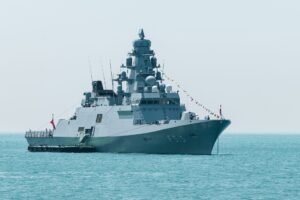


The United States launched a third round of military strikes against Iran on July 12 after Iran’s Islamic Revolutionary Guard Corps (IRGC) attacked the Cyprus flagged container ship M/V GFS Galaxy while it was transiting the Strait of Hormuz. According to U.S. Central Command (CENTCOM), the attack left one civilian crew member missing, caused a fire onboard, and inflicted significant damage to the vessel’s engine room, preventing it from continuing its voyage.
CENTCOM said the strikes began at 7:15 p.m. ET at the direction of the Commander in Chief. The U.S. said Iran had been given another opportunity to comply with the Memorandum of Understanding following previous attacks on commercial shipping but had failed to do so. Washington said the operation was intended to further degrade Iran’s ability to target civilian mariners and commercial vessels transiting the Strait of Hormuz.
CENTCOM later said it had completed the third round of strikes on July 11, hitting about 140 Iranian military targets with precision munitions launched by land and sea based fighter aircraft, drones, and naval vessels. The targets included Iranian missile and drone sites, naval capabilities, ammunition storage facilities, communication networks, and coastal surveillance locations. During three nights of operations this week, CENTCOM said it struck more than 300 targets aimed at degrading Iran’s ability to attack civilian shipping.
According to Axios, U.S. officials said the strikes targeted rocket and drone launch sites, air surveillance radars, and missile storage facilities. CENTCOM confirmed U.S. forces struck multiple locations in southern Iran. Explosions were reported in Qeshm Island, Bandar Abbas and Sirik in Hormozgan province, and in Bushehr city and Asaluyeh in Bushehr province. Iranian state media and Mehr News Agency also reported explosions in Jask, Chabahar, Deyr, Kangan, Mahshahr and Kish Island, while Iran activated air defence systems in Tehran and at Mahshahr port.
Iranian state television said three explosions were heard at the Port of Hormuz in Hormozgan province and two in Sirik. Press TV reported the IRGC announced it had closed the Strait of Hormuz until the United States stops interfering in the region. The IRGC claimed a vessel with its systems switched off attempted to transit through an unauthorized route and said Iranian forces struck the ship to prevent its passage.
A U.S. official said American negotiators did not travel to Oman for talks with Iran and that a U.S. technical team would not be present on site, although Washington would remain in contact with Oman and Qatar. The official said the U.S. had expected Iran to publicly commit to ending attacks on vessels in the Strait of Hormuz, but Iranian sources said no such commitment was made. CENTCOM also said commercial vessel traffic through the Strait of Hormuz continues, with U.S. forces helping facilitate the safe transit of more than 800 commercial vessels and 400 million barrels of crude oil through the vital waterway since early May. Iranian officials later warned the U.S. strikes would “not go unanswered,” while Israel Hayom reported Oman informed Washington that Iran had rejected proposed terms on the Strait of Hormuz.
Iran Launches Strikes on U.S. Targets Across Middle East
Iran said it has launched a new wave of strikes against U.S. positions across the Middle East, marking a sharp escalation in the conflict. Qatar raised its security alert to the highest level, urged residents to stay indoors, avoid non essential travel, and follow official instructions after explosions were reported in Doha and emergency alerts were sent to mobile phones. The UAE also said its air defence systems were intercepting Iranian missiles and drones, issuing its first missile alerts since May 7.
Iranian officials said the U.S. should comply with the terms of a memorandum of understanding and accused Washington of increasing regional tensions by trying to open what it called “illegal shipping lanes” in the Strait of Hormuz. Parliament Speaker Mohammad Bagher Ghalibaf said the era of unilateral agreements is over and warned that parties ignoring Iran’s demands would face consequences. Iran also said its military would continue defending its interests in the Strait, with potential targets being updated regularly.
The Islamic Revolutionary Guard Corps (IRGC) said it carried out a large scale third phase operation targeting U.S. forces, including a U.S. naval logistics support center and an aircraft carrier fuel replenishment platform at Duqm Port in Oman. The IRGC also claimed it stopped a second “unauthorized vessel” in the Strait of Hormuz and launched ballistic missiles at the U.S. Al Udeid Air Base in Qatar, targeting the base’s fighter maintenance support center and command and control facilities.

BBW News Desk is the editorial team of BigBreakingWire, a digital newsroom focused on global finance, markets, geopolitics, trade policy, and macroeconomic developments.
Our editors monitor government decisions, central bank actions, international trade movements, corporate activity, and economic indicators to deliver fast, fact-based reporting for investors, professionals, and informed readers.
The BBW News Desk operates under the editorial standards of BigBreakingWire, prioritizing accuracy, verified information, and timely updates on major global developments.


